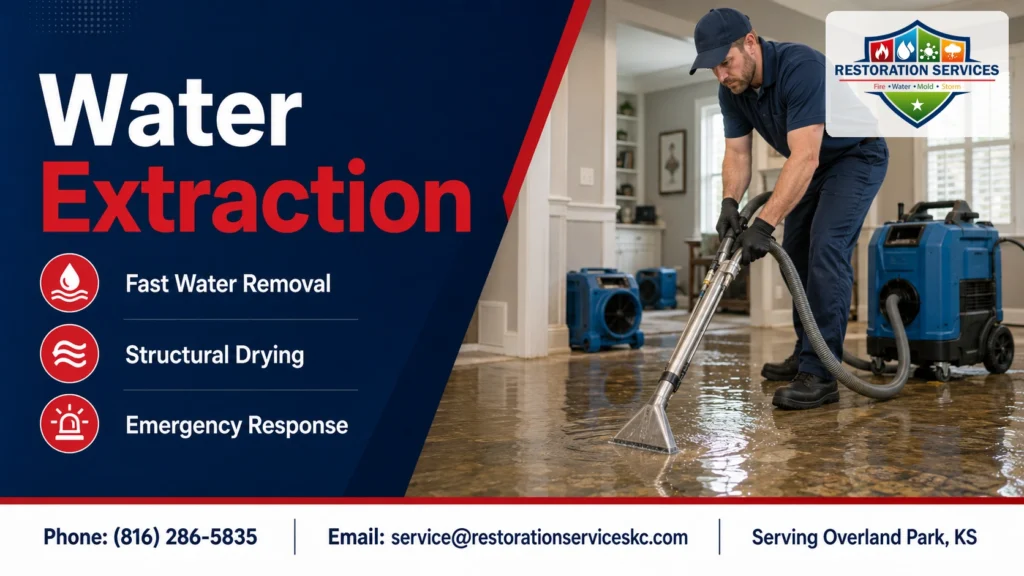
Water extraction is the controlled removal of standing and absorbed water from a property after plumbing failures, appliance leaks, sump-pump problems, basement flooding, roof leaks, storms, drain backups, sprinkler discharge, or other water events. It is the first major step in many restoration projects, but it is not the final step.
After visible water is removed, moisture can remain inside carpet padding, subfloors, drywall, insulation, framing, cabinets, ceilings, and wall cavities. A complete recovery plan combines extraction with moisture inspection, structural drying, dehumidification, cleaning, material assessment, monitoring, and repairs.
For Overland Park homes and businesses, fast action helps reduce the amount of water that spreads into adjacent materials. The EPA recommends drying wet or damp materials promptly and notes that quick action can reduce mold-growth risk.
Restoration Services KC provides extraction, drying, cleaning, sanitization, mold-prevention support, and restoration guidance throughout the Kansas City area.
This guide explains equipment, process, timing, costs, safety, local causes, insurance documentation, and what property owners should do before the team arrives.
What Is Emergency Water Removal and Why Does It Matter?
Professional extraction uses pumps, portable extractors, truck-mounted systems, specialty floor tools, and other equipment selected for the depth, source, location, and materials involved.
Removing visible water quickly matters because water moves. It follows seams, cracks, gravity, penetrations, and absorbent materials. A leak in an upstairs bathroom may affect the floor assembly, ceiling below, wall cavities, light fixtures, and adjacent rooms.
Common Overland Park causes include:
- Burst or leaking pipes
- Frozen plumbing
- Water-heater failure
- Washing-machine hose leaks
- Dishwasher overflow
- Refrigerator line leaks
- Sump-pump failure
- Heavy rain
- Roof damage
- Foundation seepage
- Drain or sewer backup
- Fire-suppression water
Extraction reduces the liquid load that drying equipment must handle. It can also allow technicians to access damaged materials and define the affected area more accurately.
The water source affects the cleanup plan. Water from a clean supply line is handled differently from sewage, floodwater, or water containing chemical or biological contaminants. Occupants should avoid entering areas with electrical hazards, structural instability, sagging ceilings, or contaminated water.
Restoration Services KC has a dedicated water extraction page for Overland Park describing emergency removal, drying, flood cleanup, basement support, and mold prevention.
Flood Water Extraction Assessment and Equipment Table
Water extraction begins with safety and source control. The team asks what happened, whether the source has stopped, how long water has been present, which rooms are affected, and what materials are wet.
| Condition | Common equipment or action | Purpose |
| Deep standing water | Submersible or transfer pump | Remove large water volume |
| Wet carpet | Extraction wand or weighted tool | Remove water from carpet and pad |
| Hard-surface water | Portable or truck-mounted extraction | Remove surface water |
| Wet wall cavity | Inspection and controlled access | Identify concealed moisture |
| High indoor humidity | Commercial dehumidifier | Remove moisture from air |
| Wet structural materials | Air movement and monitoring | Support evaporation |
| Contaminated water | Containment and protective controls | Limit exposure and spread |
| Hidden moisture | Moisture meter or thermal assessment | Map affected areas |
Water extraction equipment must be matched to the building and water conditions. More power is not always the only consideration. Technicians must protect finishes, avoid spreading contamination, and plan for electrical safety.
After extraction, the drying plan is established. Air movers circulate air across wet materials. Dehumidifiers collect moisture released into the air. Equipment placement changes as materials dry.
EPA guidance for clean-water damage identifies water extraction vacuums, air movement, dehumidification, and prompt material drying as important parts of mold prevention.
Property owners should not remove professional drying equipment early because a surface appears dry. The team uses measurements to determine whether hidden and structural materials have reached appropriate drying goals.
Why Choose Restoration Services KC for Water Extraction?
Water extraction is a core part of Restoration Services KC’s published water-damage services. The company provides local response for homes, rentals, offices, retail spaces, basements, kitchens, bathrooms, and commercial properties.
Service benefits include:
- Fast local response
- Water-source assessment
- Standing-water removal
- Moisture mapping
- Structural drying
- Dehumidification
- Cleaning and sanitization
- Mold-prevention support
- Damage documentation
- Repair guidance
The company states that its team brings more than 30 years of restoration experience to water, mold, fire, and storm projects.
A qualified provider explains the process rather than only setting equipment. Customers should understand which areas are wet, how moisture was measured, what materials are being dried, what may require removal, how long monitoring is expected, and what repairs are likely.
How Professional Water Extraction Works
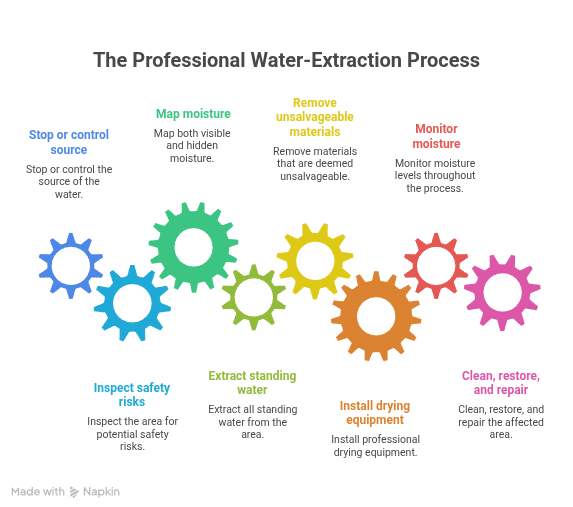
Water extraction starts with emergency information. The dispatcher may ask whether electricity is involved, whether the water is contaminated, whether the source is active, and how much of the property is affected.
When technicians arrive, they inspect the source and affected areas. If plumbing repair, roofing, sewer service, or another trade is required, source correction is coordinated before or alongside mitigation.
Standing water is removed. Contents may be relocated to provide access and protect undamaged items. Carpet and padding are assessed. Some materials can be dried; others may require removal because of contamination, swelling, delamination, structural damage, or prolonged exposure.
Moisture mapping follows. Readings are taken in affected and comparison areas. Wall bases, flooring transitions, cabinets, ceilings, insulation, and connected rooms receive close attention.
Drying equipment is installed according to the size of the loss, material types, temperature, humidity, and airflow needs. The team returns to monitor readings and adjust equipment.
Cleaning and sanitization occur according to the water source and surfaces. Odor concerns are addressed by removing contamination and moisture, not simply applying fragrance.
Finally, the team explains repair requirements. The project may need drywall, insulation, flooring, trim, cabinet, paint, or content restoration.
The Restoration Services KC water-damage service describes assessment, extraction, drying, cleaning, sanitization, content work, and reconstruction as connected stages.
Basement Water Extraction Severity and Response Table
Water extraction from a basement can involve surface runoff, sump-pump failure, plumbing leaks, sewer backup, window-well entry, foundation seepage, or appliance failure. The source must be identified because each condition requires a different permanent correction.
| Basement condition | Immediate action | Follow-up |
| Small clean-water leak | Stop source and extract | Dry walls and flooring |
| Sump-pump failure | Restore pumping and remove water | Test pump and discharge |
| Rainwater seepage | Extract and control incoming water | Correct grading or drainage |
| Window-well entry | Remove water | Repair drainage and well protection |
| Sewer backup | Restrict access | Plumbing and contaminated-water restoration |
| Wet finished walls | Moisture inspection | Dry or remove affected materials |
| Repeated musty odor | Check hidden moisture | Mold and source assessment |
Water extraction from finished basements requires attention to carpet padding, wall bases, insulation, built-in cabinets, and stored contents. Concrete may appear dry while adjacent porous materials remain wet.
Repeated water entry indicates a source problem that extraction alone cannot solve. A plumber, drainage professional, foundation specialist, roofer, or sewer contractor may be needed.
The company’s flood-cleanup guide provides additional guidance for basement and storm-related water recovery.
Water-Damage Response Tips
Water extraction is more effective when property owners act safely and avoid actions that spread damage.
Use these steps:
- Stop the source when safe
- Avoid electrical hazards
- Keep people away from contaminated water
- Move dry valuables from the area
- Photograph visible conditions
- Call restoration professionals promptly
- Notify the insurer when appropriate
Do not use an ordinary household vacuum to collect standing water. Do not enter rooms with sagging ceilings or water near live electrical systems. Do not use fans on suspected sewage contamination because uncontrolled airflow may spread contaminants.
Keep receipts for emergency repairs, temporary lodging, plumbing work, extraction, equipment, and damaged contents. Insurance coverage depends on policy terms, cause, exclusions, endorsements, and documentation.
The EPA notes that sewage or contaminated-water damage should be handled by professionals experienced with that type of loss.
Contact can be started through the Restoration Services KC emergency contact page.
Drying and Restoration After Extraction
Water extraction removes liquid water, but structural drying removes the moisture that remains in materials and indoor air. These stages should not be confused.
Air movers promote evaporation from wet surfaces. Dehumidifiers collect the released water vapor. Temperature control supports the drying environment. Moisture readings show whether materials are improving.
Drying time depends on:
- Water volume
- Time before response
- Material type
- Room temperature
- Humidity
- Airflow
- Building assembly
- Contamination
- Accessibility
- Weather
Some walls and floors can dry in place. Others require controlled removal. The technician should explain why a material is being saved or discarded.
After drying, cleaning and restoration begin. Repairs may include drywall, insulation, flooring, trim, cabinets, paint, or contents. Moisture should be resolved before new finishes are installed.
The company’s fast water extraction guide discusses extraction equipment, hidden moisture, structural drying, and mold prevention.
Frequently Asked Questions About Water Extraction
Water extraction questions usually focus on price, arrival time, equipment, drying, insurance, and mold. The actual project scope depends on inspection.
1. How much does professional water extraction cost?
Cost depends on water depth, affected square footage, source, contamination, materials, equipment, labor, drying time, removal, and repairs. A small clean-water event costs less than widespread flooding or sewage contamination.
2. How quickly should extraction begin?
Begin as soon as the area is safe and the source is controlled. Water continues moving into porous materials, and delayed drying can increase material damage and mold risk. EPA guidance recommends prompt action.
3. How long does structural drying take?
Many projects require several days, but there is no universal timeline. Material type, water volume, humidity, airflow, contamination, and hidden moisture affect drying. Measurements—not appearance alone—should guide completion.
4. Can I remove floodwater myself?
Small clean-water spills may be manageable when no hazards exist. Significant water, sewage, electrical exposure, structural concerns, or broad material damage should be handled professionally.
5. Does extraction prevent mold?
Extraction is an important first step, but complete drying and source correction are also required. Mold prevention depends on removing moisture from both visible and hidden materials.
6. Will homeowners insurance cover extraction?
Coverage depends on the policy and cause. Sudden accidental water losses may be treated differently from groundwater, flooding, maintenance problems, or sewer backup. Contact the insurer and review endorsements.
7. What should I tell the restoration company?
Explain the source, when it started, whether it is active, affected rooms, approximate water depth, electrical concerns, contamination, and any actions already taken.
Contact Information
Restoration Services KC
Phone: (816) 286-5835
Email: service@restorationserviceskc.com
Website: Restoration Services KC
Serving Overland Park, KS, and the surrounding areas.