The Water Damage Restoration Process: A Comprehensive Step-by-Step Guide to Property Recovery
Navigating the aftermath of a flood or pipe burst requires a structured and scientific approach to ensure that your property is not only dry but safe for occupancy. The water damage restoration process is a multi-phase operation designed to mitigate loss, extract moisture, and rebuild structural integrity. At Restoration Services KC, we follow IICRC-certified protocols to handle everything from initial emergency contact to final reconstruction. From our headquarters at 9202 Barton St, Overland Park, our expert teams deploy across Kansas City to provide a seamless restoration experience that prioritizes your safety and peace of mind.
The Importance of a Standardized Restoration Protocol
A standardized water damage restoration process is critical because it ensures no hidden moisture pockets are left behind to fuel mold growth or structural rot. Without a professional step-by-step plan, homeowners often make the mistake of focusing only on visible water, ignoring the moisture trapped within wall cavities and subfloors.
In my 30 years of experience as a water damage restoration specialist, I have seen how a well-executed process can save a home from total loss. I remember a project in Mission Hills where we arrived within 60 minutes of a major pipe burst. Because we followed our rigorous 7-step process—starting with moisture mapping and ending with scientific drying—we were able to save the original hardwood floors and expensive custom cabinetry. Following a professional water damage restoration process is the difference between a successful recovery and a recurring mold nightmare.
The 7 Phases of Professional Water Damage Restoration
We have refined our recovery methodology into seven distinct phases to ensure a thorough and efficient restoration.
| Phase | Primary Action | Technical Goal | Equipment Used |
| 1. Response | 24/7 Emergency Contact | Stop the water source and secure the site | Service Vehicles & Safety Gear |
| 2. Inspection | Assessment & Classification | Identify water type (Cat 1, 2, or 3) and damage extent | Thermal Cameras & Moisture Probes |
| 3. Extraction | High-Volume Water Removal | Remove standing water to stop absorption | Truck-Mounted Extractors |
| 4. Drying | Evaporation & Dehumidification | Pull moisture out of structural materials | LGR Dehumidifiers & Air Movers |
| 5. Cleaning | Sanitization & Odor Control | Eliminate bacteria and prevent musty smells | HEPA Vacuums & Antimicrobials |
| 6. Demolition | Removal of Unsalvageable Items | Clear away contaminated drywall or insulation | HEPA Air Scrubbers & Containment |
| 7. Rebuild | Final Reconstruction | Restore the property to pre-loss condition | Full Construction Tools |
Phase 1-2: Immediate Response and Forensic Inspection
The water damage restoration process begins the moment you call our emergency hotline.
Emergency Assessment: Our first priority is to identify the source of the water and ensure the area is safe from electrical hazards.
Moisture Mapping: Using infrared technology, we find exactly where the water has traveled behind walls and under floors, creating a “roadmap” for the entire restoration project.
Phase 3-4: Scientific Extraction and Controlled Drying
The heart of the water damage cleanup process lies in removing moisture at a molecular level.
Rapid Extraction: We use industrial-grade vacuums to pull water from deep within carpet padding and subflooring, which is essential to prevent mold growth.
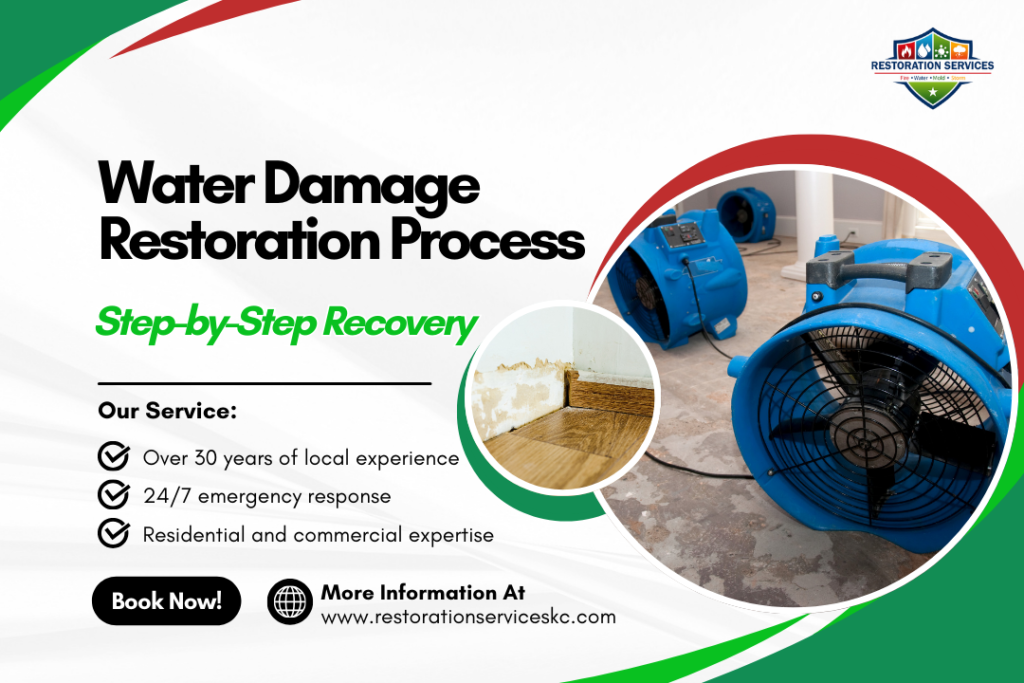
Industrial Dehumidification: Our LGR (Low Grain Refrigerant) dehumidifiers work in tandem with high-velocity air movers to evaporate moisture from the air and structural elements simultaneously.
Phase 5-7: Decontamination and Final Reconstruction
Once the property is dry, the focus shifts to safety and aesthetics.
Sanitization: We apply hospital-grade antimicrobials to kill bacteria, which is especially important in “Category 3” (black water) events.
Reconstruction: Our team handles all facets of the rebuild, from hanging new drywall to installing flooring, ensuring a turn-key solution for Kansas City homeowners.
Frequently Asked Questions: The Restoration Process
How long does the entire water damage restoration process take?
The drying phase typically takes 3 to 5 days. The total timeline, including reconstruction, depends on the extent of the damage but usually ranges from one to two weeks.
Can I perform the restoration process myself?
While you can mop up surface water, you cannot replicate the deep extraction and dehumidification needed to prevent long-term rot and mold. Professional equipment is a necessity for a safe recovery.
Will insurance cover every step of the process?
Most water damage restoration projects are covered by insurance if the cause was “sudden and accidental.” We work directly with your adjuster to document every phase for your claim.
Why is the “classification” of water important in the process?
Knowing if the water is clean (Cat 1), gray (Cat 2), or black (Cat 3) determines the level of cleaning and personal protective equipment (PPE) required for the project.
Do you provide moisture readings throughout the process?
Yes. We monitor and record moisture levels daily to ensure that the structural materials have reached their “dry standard” before we begin reconstruction.
Start Your Recovery with Restoration Services KC
When disaster strikes, you need a partner who knows the path back to normal. At Restoration Services KC, we combine 30 years of local experience with a disciplined, scientific water damage restoration process. Whether you’re dealing with a flooded basement or a major storm event, our Overland Park team is ready to respond 24/7 to protect your investment and your health.
Official Contact Details
Emergency Hotline: (816) 286-5835
Office Address: 9202 Barton St, Overland Park, KS 66214, United States
Email: joemarshall339@gmail.com
Website: restorationserviceskc.com