A sewer line cleanout is one of the most important access points in a property’s plumbing system, yet many homeowners never notice it until wastewater starts backing up into a basement, bathroom, or utility room. When a sewer line becomes partially or completely blocked, wastewater cannot flow normally toward the municipal sanitary sewer. Instead, it may return through the lowest plumbing fixtures inside the building, creating health risks, property damage, unpleasant odors, and expensive repairs.
In Overland Park, KS, sewer line problems can develop for many reasons. Older neighborhoods often have aging sewer laterals or mature trees whose roots gradually enter underground pipes. Newer developments are not immune either, as grease buildup, non-flushable products, improper drain use, or heavy rainfall can all contribute to drainage problems. A blockage that begins as a slow drain may eventually become a full sewer backup if it is ignored.
Understanding how a sewer line cleanout works allows property owners to recognize warning signs early, communicate more effectively with plumbing professionals, and reduce the risk of contamination inside the home or business.
It is equally important to understand the difference between clearing a blocked sewer line and restoring a property after sewage contamination. A licensed plumbing contractor addresses the blockage itself, while restoration professionals focus on removing contaminated water, inspecting moisture, drying affected building materials, and helping return the property to a safe condition after the plumbing issue has been resolved.
This guide explains how sewer line cleanout access works, what causes sewer blockages, how to recognize early warning signs, when professional cleaning becomes necessary, and what property owners in Overland Park should know before a minor plumbing issue becomes a major restoration project.
What Is a Sewer Line Cleanout?
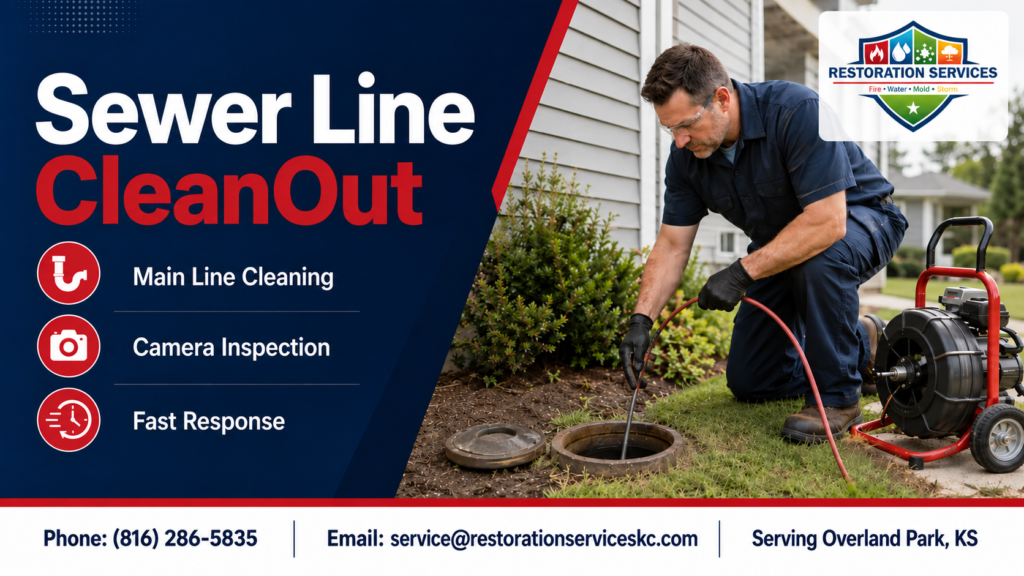
A sewer line cleanout is a dedicated access point installed along the property’s private sewer lateral. It allows qualified plumbing professionals to inspect, diagnose, and clear blockages without removing toilets or dismantling indoor plumbing fixtures.
Most residential and commercial properties have at least one cleanout, although its location depends on the property’s age, construction, and plumbing layout. It may be installed:
- Near the home’s exterior foundation
- Inside a basement or utility room
- Close to the property line
- Along the sewer lateral between the building and the municipal sewer connection
Because the cleanout provides direct access to the main sewer line, technicians can use specialized equipment such as drain snakes, mechanical cable machines, root-cutting tools, hydro-jetting systems, and sewer camera inspection equipment to locate and remove obstructions more efficiently.
Many homeowners mistakenly believe the cleanout itself is the problem when they notice wastewater around it. In reality, an overflowing cleanout usually indicates that wastewater cannot move farther downstream, making it an important warning sign rather than the cause of the blockage.
Why Sewer Line Problems Are Common in Overland Park
Every property’s plumbing system ages differently, and local conditions play a significant role in sewer performance.
Throughout Overland Park, plumbing professionals frequently encounter properties with mature landscaping, changing soil conditions, seasonal temperature fluctuations, and heavy rain events that place additional stress on underground sewer systems. While each property is unique, these conditions can increase the likelihood of sewer-related problems if routine maintenance is neglected.
For example, neighborhoods with large established trees may experience root intrusion into older sewer laterals, while restaurants and commercial kitchens often deal with grease accumulation inside drain lines. Residential properties are more likely to experience blockages caused by excessive toilet paper, hygiene products marketed as “flushable,” cooking grease, food waste, or accumulated debris.
Heavy rainfall may also reveal existing weaknesses within the system. A pipe that normally drains adequately can begin backing up when an existing restriction combines with increased water flow or groundwater infiltration.
Understanding these local factors helps property owners respond earlier instead of waiting until sewage enters the building.
Common Causes of Sewer Line Blockages
A blocked sewer line rarely develops overnight. In many cases, restrictions build gradually before becoming a complete obstruction.
Some of the most common causes include:
- Tree root intrusion through small pipe joints or cracks
- Grease, fats, oils, and food residue accumulating inside drain pipes
- Non-flushable wipes, paper towels, hygiene products, and foreign objects
- Aging clay, cast iron, or deteriorated sewer pipes
- Pipe misalignment, settlement, or bellied sections that collect waste
- Construction debris left inside new or repaired plumbing systems
- Mineral buildup that gradually reduces pipe diameter
- Collapsed or severely damaged sewer laterals
Not every blockage requires excavation. Many restrictions can be removed through professional sewer cleaning, while structural failures may require repair, pipe lining, or replacement after a camera inspection confirms the condition of the line.
Early Warning Signs You Should Never Ignore
One slow sink does not necessarily indicate a main sewer problem. However, when multiple plumbing fixtures begin behaving unusually at the same time, the issue may involve the property’s main sewer lateral rather than a single drain.
Ignoring these early warning signs often allows wastewater pressure to build until sewage escapes through the lowest available opening inside the structure.
| Warning Sign | What It May Indicate | Recommended Next Step |
| Multiple slow drains | Developing main sewer restriction | Reduce water use and schedule a sewer inspection |
| Toilet bubbles while another fixture drains | Shared sewer line blockage | Stop high-volume water use and seek professional diagnosis |
| Sewage backing up into a basement floor drain | Main sewer line obstruction | Contact a licensed sewer professional immediately |
| Strong sewer odor indoors | Damaged sewer line, dry trap, or hidden leak | Arrange a professional inspection |
| Water backing into a shower or bathtub | Restricted sewer lateral | Avoid additional water use until the cause is identified |
| Overflowing outdoor cleanout | Downstream blockage in the sewer line | Keep clear of wastewater and request emergency service |
Many people continue using sinks, washing machines, or toilets after noticing these symptoms. Unfortunately, additional water entering the plumbing system often forces more contaminated wastewater back into the building, increasing cleanup costs and expanding the affected area.
For that reason, early diagnosis is often far less expensive than waiting until a complete sewer backup occurs.
Sewer Line Cleaning vs. Property Restoration
One of the biggest misconceptions among property owners is that clearing a sewer blockage automatically solves the entire problem.
In reality, these are two separate stages of recovery.
A plumbing contractor focuses on restoring wastewater flow by locating the blockage, cleaning the sewer line, and recommending repairs if structural damage exists.
If contaminated water has already entered the property, however, additional work may still be necessary. Porous materials such as drywall, carpet, insulation, wood trim, and stored contents can retain moisture and contamination even after the drain begins working normally again.
This is where restoration becomes important.
Restoration Services KC focuses on the property recovery process after sewer backups, water intrusion, and related damage. Once the plumbing issue has been addressed, the team can assist with water extraction, moisture assessment, structural drying, cleanup planning, documentation, and restoration of affected building materials.
Separating these two services helps property owners understand why both plumbing professionals and restoration specialists may be involved during the same sewer backup event.
How Professional Sewer Line Cleanout Works
When a property’s drainage system begins showing signs of a blockage, many homeowners assume the solution is simply running a drain snake through the nearest pipe. In reality, professional sewer line cleanout service is a systematic process that focuses on identifying the actual cause of the restriction before selecting the safest cleaning method.
The goal is not only to restore wastewater flow but also to determine whether the problem is temporary or a sign of a larger issue affecting the sewer lateral.
Experienced technicians usually begin by asking several practical questions, including:
- When did the drainage problem first begin?
- Are multiple plumbing fixtures affected?
- Has the property experienced previous sewer backups?
- Has the sewer line ever been repaired or replaced?
- Are large trees located near the sewer lateral?
- Has wastewater appeared inside the building or around the outdoor cleanout?
These answers help narrow the possible causes before equipment is brought into the property.
The next step is locating the most suitable sewer line cleanout access. Many homes have an exterior cleanout near the foundation or property line, while others have an interior cleanout inside a basement, utility room, or mechanical area. Using the cleanout allows technicians to reach the blockage directly instead of removing toilets or opening interior plumbing fixtures whenever possible.
Choosing the Right Cleaning Method
Every sewer blockage is different. The safest and most effective cleaning method depends on the pipe material, blockage type, and overall condition of the sewer line.
For example, a grease buildup inside a restaurant’s drain system requires a different approach than tree roots growing into an aging clay sewer lateral.
| Cleaning Method | Best Used For | Important Consideration |
| Mechanical Drain Snake | Paper, debris, and moderate blockages | Quickly restores flow but may leave buildup on pipe walls. |
| Root-Cutting Equipment | Tree root intrusion | Removes roots but recurring root growth may indicate pipe damage. |
| Hydro Jetting | Grease, sludge, soap buildup, and heavy deposits | Works best on structurally sound pipes after professional evaluation. |
| Sewer Camera Inspection | Unknown or recurring problems | Identifies cracks, offsets, root intrusion, standing water, or collapsed sections before major repairs are recommended. |
One common misconception is that hydro jetting is always the best solution. While high-pressure water can thoroughly clean many sewer pipes, older clay, cast iron, or deteriorated sewer lines may require careful inspection before high-pressure cleaning is performed. Selecting the wrong method can sometimes worsen existing structural damage.
That is why experienced professionals prioritize diagnosis before treatment instead of using the same solution for every blockage.
When Cleaning Isn’t Enough
Not every sewer problem can be solved by clearing the blockage.
Sometimes the obstruction is only a symptom of a much larger issue hidden underground.
A sewer camera inspection may reveal problems such as:
- Cracked sewer pipes
- Offset pipe joints caused by soil movement
- Collapsed pipe sections
- Severe corrosion in aging cast iron lines
- Bellied sewer lines that continuously collect wastewater
- Repeated tree root intrusion through damaged joints
- Improper pipe slope causing poor drainage
In these situations, restoring flow may only provide temporary relief.
Instead, a plumbing contractor may recommend spot repairs, trenchless pipe lining, pipe bursting, or full sewer lateral replacement depending on the severity of the damage.
Understanding this distinction helps property owners avoid repeated service calls that temporarily remove the blockage without addressing the underlying cause.
Local Sewer Challenges in Overland Park
Although every property is different, plumbing professionals working throughout Overland Park often encounter conditions that increase the likelihood of sewer line problems.
Older neighborhoods may contain aging clay or cast iron sewer laterals that have been in service for decades. Small cracks or separated joints can gradually allow tree roots to enter the pipe, eventually restricting wastewater flow.
Properties with mature landscaping often require periodic inspections because root intrusion usually develops slowly rather than appearing overnight.
Commercial buildings, restaurants, and food-service facilities face different challenges. Grease accumulation inside drain lines can narrow the pipe over time, making routine maintenance more important than emergency cleaning after a blockage develops.
Heavy rainfall can also expose weaknesses that previously went unnoticed. If a sewer lateral already contains partial obstructions, additional groundwater or storm-related stress may increase the likelihood of backups during severe weather.
For these reasons, recurring sewer problems should never be viewed as “normal.” Repeated blockages often indicate an underlying issue that deserves professional investigation instead of repeated temporary cleaning.
When a Sewer Backup Becomes a Property Damage Problem
A blocked sewer line is primarily a plumbing issue until contaminated wastewater enters the building.
Once sewage reaches finished living areas, the situation changes significantly.
Contaminated water can spread beneath flooring, soak drywall, damage insulation, affect cabinetry, enter wall cavities, and reach stored belongings long before all visible water disappears.
Simply removing standing wastewater does not guarantee that hidden moisture or contamination has been eliminated.
This is why sewer backups often require two different professionals working together.
A licensed plumbing contractor restores proper drainage by clearing or repairing the sewer line.
A restoration company focuses on the affected property itself.
After the plumbing source has been controlled, Restoration Services KC can assist with:
- Water extraction from affected areas
- Moisture inspection using professional equipment
- Structural drying
- Evaluation of affected building materials
- Cleanup planning
- Documentation for restoration work
- Repair and reconstruction guidance
This coordinated approach helps reduce the risk of lingering moisture, persistent odors, and additional damage after the sewer system is functioning normally again.
Why Waiting Can Increase Restoration Costs
One of the most expensive mistakes property owners make is assuming the problem has been solved simply because the drains begin working again.
Hidden moisture may remain inside flooring systems, drywall, insulation, framing, or finished basement materials even after wastewater disappears from the surface.
The longer contaminated materials remain wet, the more difficult recovery can become.
Prompt action not only protects the property’s condition but may also simplify the overall restoration process by limiting how far contamination spreads.
Because of that, professional assessment is often recommended whenever sewage has entered occupied living or working spaces, even if the visible water appears minimal.
Sewer Line Maintenance Tips for Long-Term Protection
While no sewer system is completely maintenance-free, many major sewer backups begin with small warning signs that are overlooked. Preventive maintenance is far less expensive than repairing water damage after a sewage backup, especially when finished basements, flooring, drywall, or stored belongings are involved.
Property owners should think of their sewer lateral as part of the building’s long-term maintenance plan rather than something that only needs attention after a blockage occurs.
The following practices can significantly reduce the likelihood of unexpected sewer problems:
- Flush only toilet paper and human waste. Even products labeled as “flushable” may not break down properly inside a sewer line.
- Never pour cooking grease, fats, or oils into kitchen drains. As they cool, they can harden and gradually restrict wastewater flow.
- Schedule a professional sewer camera inspection if your property has experienced repeated backups, slow drains, or tree root intrusion in the past.
- Keep the exterior sewer cleanout accessible. Landscaping, mulch, decorative stones, or outdoor structures should never permanently cover the cleanout cap.
- Address recurring drainage problems early rather than repeatedly using chemical drain cleaners, which generally do not resolve main sewer line issues.
- If your property contains mature trees near the sewer lateral, periodic inspections may identify root intrusion before a complete blockage develops.
Preventive maintenance does not eliminate every risk, but it greatly improves the chance of identifying developing problems before wastewater enters the building.
What to Do If Your Sewer Line Backs Up
A sewer backup can become worse within minutes if water continues flowing through the plumbing system.
If multiple fixtures begin backing up or sewage enters the property, taking the right steps immediately can help reduce additional damage.
- Stop using sinks, toilets, washing machines, dishwashers, and other plumbing fixtures connected to the affected sewer line.
- Keep family members, employees, tenants, and pets away from contaminated water whenever possible.
- If it is safe to do so, photograph the affected areas before cleanup begins.
- Contact a qualified plumbing or sewer professional to diagnose and clear the blockage.
- If wastewater has entered finished areas, arrange a professional restoration assessment as soon as possible.
- Avoid attempting to disinfect large contaminated areas with household cleaners alone. Proper cleaning, moisture assessment, and drying procedures depend on the extent of contamination.
Many property owners focus only on restoring drainage. However, once sewage has affected drywall, flooring, insulation, cabinetry, or other porous materials, professional restoration may still be necessary even after the plumbing problem has been corrected.
Why Property Restoration Matters After a Sewer Backup
Removing a blockage is only one part of the recovery process.
When contaminated wastewater enters a home or commercial building, hidden moisture can remain beneath flooring, inside wall cavities, around insulation, and within structural materials that appear dry from the surface.
If these materials are not properly evaluated, cleaned, and dried, the property may continue experiencing unpleasant odors, material deterioration, or additional moisture-related problems.
After the plumbing source has been controlled, Restoration Services KC supports property recovery by assessing affected areas, extracting water, inspecting moisture, planning structural drying, documenting damage, and coordinating the restoration process based on the condition of the building materials.
Taking a coordinated approach between plumbing professionals and restoration specialists often results in a more complete recovery than addressing only the blocked sewer line.
Frequently Asked Questions About Sewer Line Cleanout
What is a sewer line cleanout?
A sewer line cleanout is an access point installed on a property’s private sewer lateral. It allows qualified professionals to inspect, clean, and diagnose the main sewer line without removing interior plumbing fixtures.
What are the signs that my main sewer line is clogged?
Common warning signs include multiple slow drains, toilets that bubble when other fixtures are used, sewage backing up into a basement floor drain, unpleasant sewer odors, water returning through showers or tubs, and an overflowing outdoor cleanout.
3. Is hydro jetting better than using a drain snake?
It depends on the condition of the sewer line and the type of blockage. A drain snake is often effective for localized obstructions, while hydro jetting is better suited for removing grease, sludge, and heavy buildup in structurally sound pipes. A professional inspection helps determine the safest method.
Can tree roots grow back after sewer line cleaning?
Yes. Cleaning removes existing roots, but if damaged joints or cracks remain, roots may return over time. A camera inspection can help determine whether pipe repair or replacement is necessary to prevent recurring intrusion.
Who is responsible for maintaining the private sewer lateral?
In most situations, property owners are responsible for maintaining, repairing, and replacing the private sewer lateral that connects the building to the public sanitary sewer system. Local requirements may vary depending on the property and municipality.
When should I call a restoration company after a sewer backup?
If contaminated wastewater reaches flooring, drywall, insulation, cabinets, furniture, or multiple rooms, restoration should begin as soon as the plumbing source has been controlled. Early response can help reduce further damage and support a safer recovery.
How can I reduce the risk of future sewer backups?
Routine sewer inspections, responsible drain use, keeping grease and non-flushable items out of the plumbing system, maintaining accessible cleanouts, and addressing recurring drainage issues promptly are some of the most effective preventive measures.
Protect Your Property Before a Small Sewer Problem Becomes a Major Restoration Project
A blocked sewer line can quickly progress from a plumbing inconvenience to a serious property-damage event if contaminated wastewater enters your home or business. Recognizing the warning signs early, arranging professional sewer line cleaning when needed, and responding promptly after a backup can help reduce repair costs and minimize disruption.
If your property has been affected by a sewer backup, Restoration Services KC can assist after the plumbing issue has been addressed. The team provides professional support for water extraction, moisture inspection, structural drying, cleanup planning, damage documentation, and property restoration to help you move forward with confidence.
Contact Restoration Services KC today to schedule an assessment and learn more about restoring your property after sewer-related water damage.